
By: Susan Berube
Have you ever found yourself discussing key issues with a friend, family member, or acquaintance, and they say, “I’m not into politics”? What does your response become to that question? My response is that in contemporary life, I feel as though everything has become political, with key issues regarding morality, ethics, and basic human rights. It’s important now more than ever to “get into” politics and start advocating for your beliefs.
Human Rights
Although human rights are supposed to be protected under the Constitution, many are at risk of being revoked due to ongoing controversy within the United States.
Birthright Citizenship
In 1868, the U.S. ratified the Fourteenth Amendment’s Citizenship Clause, declaring that “all persons born or naturalized in the U.S. and subject to the jurisdiction thereof are citizens”. This protects all persons born in the United States whose parents are not citizens/were born elsewhere and migrated to the United States.
On Trump’s first day back in office, he issued an executive order redefining birthright citizenship, stating that a child born in the U.S. is not a citizen if their mother does not have legal immigration status or is here legally but temporarily, and their father is not a U.S. citizen or lawful permanent resident. Naturally, this was very controversial and was brought to the Supreme Court for a hearing on April 1st, 2026.
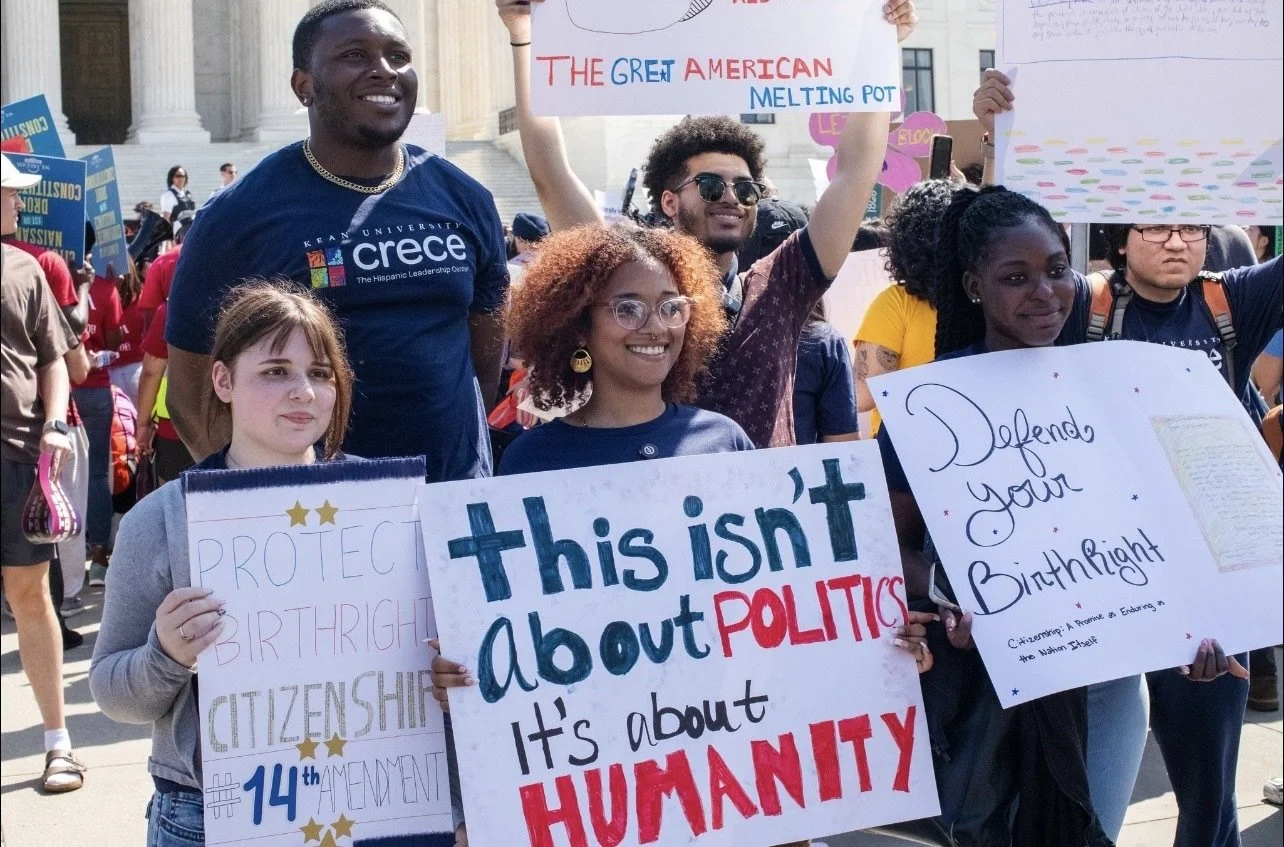
Lesniak Institute for American Leadership at the Birthright Citizenship Rally at Washington DC. 2026
Abortion
In 1973, the Supreme Court, in Roe v. Wade, ruled that under the Fourteenth Amendment, the Constitution grants any person the liberty to choose to have an abortion. In 2022, however, the Supreme Court overturned Roe v. Wade, ruling that the Constitution does not explicitly grant anyone the right to an abortion, leaving the authority to regulate or prohibit abortion to the individual states.
Since then, the New York Times shows that 13 states have issued a FULL ban on abortion: Alabama, Arkansas, Idaho, Indiana, Kentucky, Louisiana, Mississippi, North Dakota, Oklahoma, South Dakota, Tennessee, Texas, and West Virginia. Other states have laws asserting that an abortion is banned after a certain number of weeks.
Free Speech
Another human right, free speech, has been under attack during the current administration through many different forums, such as social media, books, and protests.
Book Banning
There has been a recent escalation in the campaign for book banning, with many seeing this as a form of censorship and a direct threat to our First Amendment right to free speech. According to the American Library Association, in 2023, book bans hit a record high in libraries across the country. In 2025, the Pentagon ordered all military leaders to review all of their library books that touched on topics of diversity, anti-racism, and gender issues.
There have been some states prohibiting this, such as New Jersey, in which Governor Murphy signed a law preventing public and school libraries from banning books. However, this is still a major concern in many other states that are trying to censor and hide history.
Peaceful Protests
The right to peacefully protest is slowly being revoked, as protests are beginning to be distorted by the current administration.
For example, in June of last year, thousands of protesters took to the streets of Los Angeles to protest ongoing ICE raids. The administration, under President Trump’s command, deployed the National Guard to said protests, which the governor of California, Gavin Newsom, called inflammatory, as this was done without his request and caused major clashes between the protestors and the deployed troops.
Climate Change
Climate change, a phenomenon that has been scientifically proven, is still being questioned and pushed to the side, even though we are seeing major consequences of this every year.
Dismantling Research Centers
As of December 2025, President Trump announced his plan to dismantle the National Center for Atmospheric Research (NCAR), the country’s largest federal climate research center. It focuses on natural disasters such as hurricanes and wildfires, aiming to research more about their tendencies to develop predictions and solutions. The center also operates supercomputers used for complex modeling work.
Yale Climate Connections states, “February 2026 was the world’s fifth-warmest February in analyses of global weather data going back to 1850, NOAA’s National Centers for Environmental Information, or NCEI, reported March 11th.” Recent months have also seen unpredictable weather, such as a surge of snowstorms, heat waves, and hurricane-like rain/wind. In dismantling research centers, scientists are less likely to find solutions to control climate change.
Expanding Gas and Oil Drilling in Alaska
During President Trump’s second term, he has made efforts to expand oil and gas drilling in Alaska’s National Petroleum Reserve. This will open nearly 82% of the 23-million-acre reserve to drilling. In regard to climate change, this will increase damage to Alaska and the planet as a whole through the burning of fossil fuels. Wildlife that depend on Alaska's habitat will also be at risk due to this expansion.
Education
Education is what empowers nations – but what happens when an administration doesn’t want you to be educated?
Staffing Cuts within the Department of Education
President Trump signed an executive order to dismantle the Department of Education, and since then, he has reduced its workforce by nearly 50%. Staff members who have been laid off included those in the Office of Elementary and Secondary Education (OESE), Office of Special Education and Rehabilitative Services (OSERS), and Office for Civil Rights (OCR).
This workforce reduction could lead to delayed funding distribution for Title I schools, rural schools, and special education programs. Ultimately, access to quality education, financial resources, and specialized help could be severely affected.
Healthcare Accessibility and Affordability
Many think healthcare should be considered a basic human right, but as it currently stands, it seems more like a luxury.
Affordable Care Act (ACA)
The Affordable Care Act, also known as Obamacare, was enacted in 2010 under President Obama. This act aims to make affordable healthcare insurance available to low-income families, such as those with incomes between 100% and 400% of the federal poverty level (FPL).
The Senate voted in December of last year to reject a health care bill that would have extended the ACA by another three years. In rejecting this bill, it is more likely that premiums for those under Obamacare will nearly double in cost.
Debunking Political Myths
1. “My vote/voice doesn’t matter.”
Your vote has the power to change the outcome of an entire election! Believe it or not, according to The Center for American Progress, the 2020 presidential election was decided by 42,918 votes out of the 158 million votes cast. Since the election is determined by electoral votes as opposed to the popular vote, 42,918 regular citizens were able to determine the results of the election by simply showing up and making their voice heard!
2. “I don’t have the power to change anything.”
You have the power to change everything! Take Ruth Bader Ginsburg, for example, a former U.S. Supreme Court justice born in Brooklyn, NY. In her early life, she struggled with gender discrimination/bias as she could not find a law firm that would hire a woman. However, her determination fueled her career, becoming the second woman to serve on the Supreme Court and winning five out of six landmark cases to dismantle gender-based legal stereotypes.
Her story should be an inspiration to all, as it shows that a single person can make a difference regardless of their start-up.
3. “Politicians don’t listen.”
Our very own founder, Senator Raymond Lesniak, made his final decision regarding the legal age to purchase, possess, or consume alcohol in New Jersey by listening to one of its very own residents and their connection to legal drinking.
The day before the vote was going to take place regarding the legal drinking age, Senator Lesniak’s car had broken down on his way to the New York State Thruway. He called a local gas station, whose owner came to pick him up in his tow truck. Senator Lesniak mentioned to the owner that he had to be in New Jersey the next day to vote on the legal drinking age in NJ. The attendant began sharing a personal anecdote about how he lost his daughter to a drunk driver who appeared to be around 18 years old. This occurrence, which happened by coincidence, finalized his decision to keep the drinking age at 21.
Politicians do listen! They hear your stories and your experiences, and these are the driving motivations for many of their decisions.
Fight for Your Rights
Keeping yourself informed in the political world is critical in contemporary life. Our rights are at risk and it is up to you to advocate, protest, reach out to legislators, and work with others to make our world a better place. You may be just one, but together, we’re many – and we can make a difference.
About the Author: Susan Berube is Service Specialist Intern at The Lesniak Institute. She is an aspiring government official and a current undergraduate student at Kean University pursuing a dual degree in English and Communications - Journalism. She is passionate about human rights and civic action.